Modern infrastructure projects—metro systems, bridges, power plants, ports, and industrial zones—depend on the ability to move extremely heavy components with precision and safety. Among all lifting equipment used today, the 50 ton gantry crane has become one of the most important “backbone machines” in large-scale construction environments. Its combination of high lifting capacity, outdoor mobility, and structural stability makes it a core asset in modern engineering projects.
This article explains how 50 ton gantry cranes support infrastructure construction, where they are used, and why they are essential in today’s fast-growing industrial world.
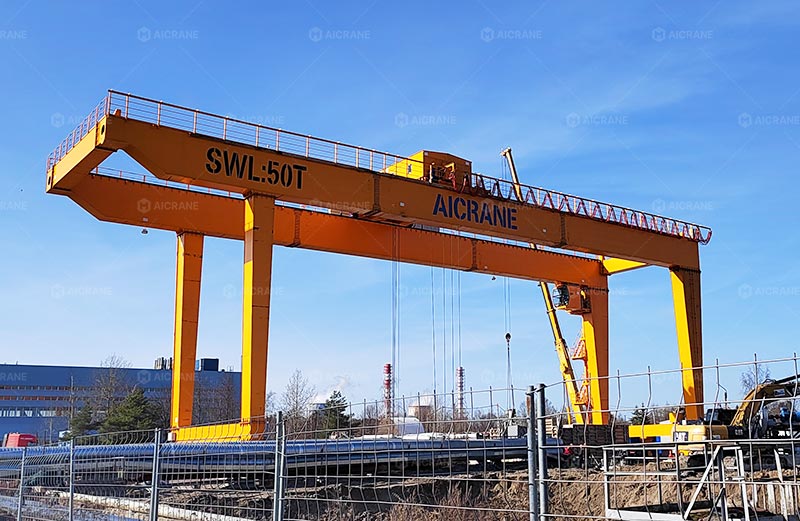
1. What Makes a 50 Ton Gantry Crane Special?
A 50 ton gantry crane is a heavy-duty lifting system capable of handling loads up to 50,000 kg. It is typically designed with a double-girder structure, supported by two strong legs that move along ground rails or heavy-duty wheels.
Unlike overhead cranes that require building columns and indoor runway beams, double girder gantry cranes are freestanding systems. This means they can be installed in open construction sites, ports, and infrastructure zones without major building modifications.
Key characteristics include:
- High lifting capacity (50 tons)
- Wide span (often 18–35 meters or customizable)
- Outdoor and indoor adaptability
- Rail-mounted or rubber-tyred mobility options
These features make them ideal for infrastructure environments where flexibility and strength are equally important.
2. Essential Role in Infrastructure Construction
2.1 Metro and Tunnel Construction
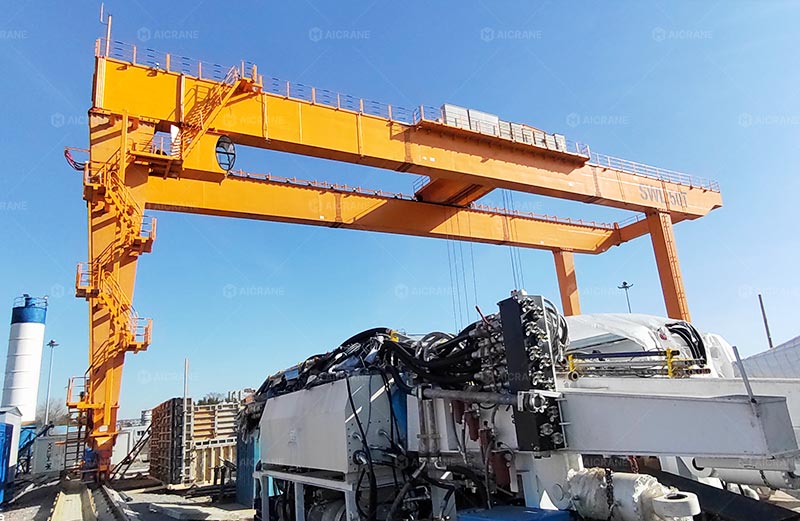
One of the most critical applications of 50 ton gantry cranes is in metro and tunnel engineering. During subway construction, large components such as shield machine parts, tunnel segments, and precast rings must be lifted and positioned with high precision.
For example, in metro shaft construction, gantry cranes are used to:
- Lift tunnel boring machine (TBM) components
- Install precast pipe segments
- Handle heavy reinforcement cages
Because construction shafts are often narrow and deep, traditional cranes cannot operate effectively. Gantry cranes solve this limitation by working within confined spaces while maintaining high lifting capacity.
2.2 Bridge and Highway Construction
Infrastructure projects like bridges and elevated highways require extremely heavy structural elements, such as:
- Steel girders
- Concrete bridge segments
- Precast beams
A 50 ton gantry crane is often used in precast yards and bridge assembly sites, where it helps:
- Lift beams from casting beds
- Transport segments to storage areas
- Load components for transportation to the installation site
In many modern bridge construction projects, gantry cranes significantly improve efficiency by enabling continuous production and movement of precast elements.
2.3 Precast Concrete Manufacturing Yards
Precast yards are a major part of modern infrastructure development. Here, 50 ton gantry cranes are essential for:
- Moving precast beams and slabs
- Handling molds and formworks
- Loading finished components onto transport vehicles
The crane’s ability to operate along long production lines allows factories to maintain a continuous workflow, reducing downtime and increasing output.
Without gantry cranes, precast production would be slower, less safe, and heavily dependent on multiple smaller lifting machines.
2.4 Power Plants and Energy Projects
Power plant construction involves extremely heavy equipment, including:
- Turbines
- Generators
- Transformers
- Boiler components
A 50 ton gantry crane plays a critical role in both installation and maintenance phases.
It ensures:
- Safe lifting of high-value equipment
- Precise positioning during assembly
- Reduced risk of equipment damage
In nuclear, hydro, and thermal power projects, the crane’s precision and stability are as important as its lifting capacity.
2.5 Ports, Shipyards, and Logistics Hubs
Infrastructure is not limited to land-based construction. Ports and shipyards also rely heavily on gantry cranes for:
- Container handling
- Ship component installation
- Steel structure loading/unloading
Rail-mounted and rubber tyred gantry cranes are widely used in logistics yards because they can move heavy loads efficiently across large open areas.
In these environments, a 50 ton capacity allows operators to handle:
- Containers
- Heavy machinery parts
- Steel coils and fabricated structures
3. Why 50 Ton Gantry Cranes Are Ideal for Infrastructure
3.1 High Load Capacity for Heavy Components
Infrastructure components are becoming larger and heavier due to modern engineering standards. A 50 ton capacity ensures the crane can handle most:
- Structural beams
- Precast segments
- Industrial equipment modules
This reduces the need for multiple lifting operations, improving efficiency.
3.2 Mobility and Site Flexibility
Unlike fixed cranes, gantry cranes can:
- Travel along rails
- Move across large construction yards
- Operate in multiple zones of a project site
This flexibility is crucial in infrastructure projects where construction phases constantly change.
3.3 Precision Handling for Complex Installation
Modern infrastructure requires millimeter-level precision during installation. Gantry cranes provide:
- Smooth horizontal movement
- Controlled lifting and lowering
- Stable load suspension
This reduces installation errors, especially in bridge alignment or tunnel segment placement.
3.4 Reduced Dependency on Large Tower Cranes
While tower cranes are useful for vertical construction, they are less effective for horizontal movement of heavy prefabricated components. Gantry cranes fill this gap by offering:
- Better ground-level control
- Higher portability
- More flexible working radius
4. Engineering Features That Support Infrastructure Work
A 50 ton gantry crane is not just powerful – it is engineered for demanding environments.
Key features include:
- Double girder structure for rigidity and reduced deflection
- Heavy-duty rail systems for long-distance movement
- Advanced hoisting systems for smooth lifting
- Safety protection systems (overload limiters, wind alarms, anti-collision devices)
- Custom span and height configurations for project-specific needs
These features ensure stable performance even in harsh outdoor environments such as coastal ports or large construction zones.
5. Safety Importance in Infrastructure Projects
Infrastructure construction involves high-risk operations. A 50 ton gantry crane contributes to safety by:
- Reducing manual lifting risks
- Providing stable mechanical support
- Preventing uncontrolled load movement
- Ensuring precise positioning of heavy materials
Most modern cranes also include smart monitoring systems that track load conditions and operational safety in real time.
6. Future Role in Smart Infrastructure
As infrastructure becomes more digital and automated, gantry cranes are also evolving. Future trends include:
- Remote control and semi-automation
- IoT-based load monitoring
- Predictive maintenance systems
- Integration with BIM (Building Information Modeling)
These advancements will make 50 ton gantry cranes even more essential in smart construction ecosystems.
Conclusion
The 50 ton gantry crane is far more than a lifting machine – it is a critical enabler of modern infrastructure construction. From metro tunnels and bridge segments to power plants and port logistics, it ensures that heavy materials are moved safely, efficiently, and precisely.
Its combination of strength, flexibility, and engineering sophistication makes it one of the most valuable assets in today’s construction industry. As global infrastructure projects continue to grow in scale and complexity, the role of the 50 ton gantry crane will only become more important in shaping the cities and systems of the future.