Large concrete pavement projects are fundamentally different from small slab or building works because concrete placement often proceeds continuously across long and relatively narrow work fronts. Highways, airport aprons, container yards, industrial roads, and major logistics pavements may require thousands of cubic meters of concrete while maintaining consistent thickness, elevation, strength, and surface quality. A disruption at any point can propagate downstream: insufficient batching capacity leaves the paving machine waiting, delayed trucks interrupt the placement rhythm, and inconsistent concrete properties can affect finishing and compaction. For this reason, concrete production, transportation, and paving must operate as one coordinated construction system.
The equipment chain typically begins with a batching plant mobile or another concrete batching system, continues through a fleet of concrete mixer trucks, and ends with a concrete paving machine. Each link has a distinct role, but none operates in isolation. The batching plant determines how much fresh concrete can be produced, mixer trucks regulate the material flow between production and placement, while the concrete paver machine for sale determines how efficiently that concrete can be distributed, compacted, and shaped. The construction characteristics of the pavement itself ultimately determine how these machines should be configured and scheduled.
Why Large Concrete Pavement Projects Need Synchronized Concrete Supply
Continuous Paving Creates a Time-Sensitive Production Cycle
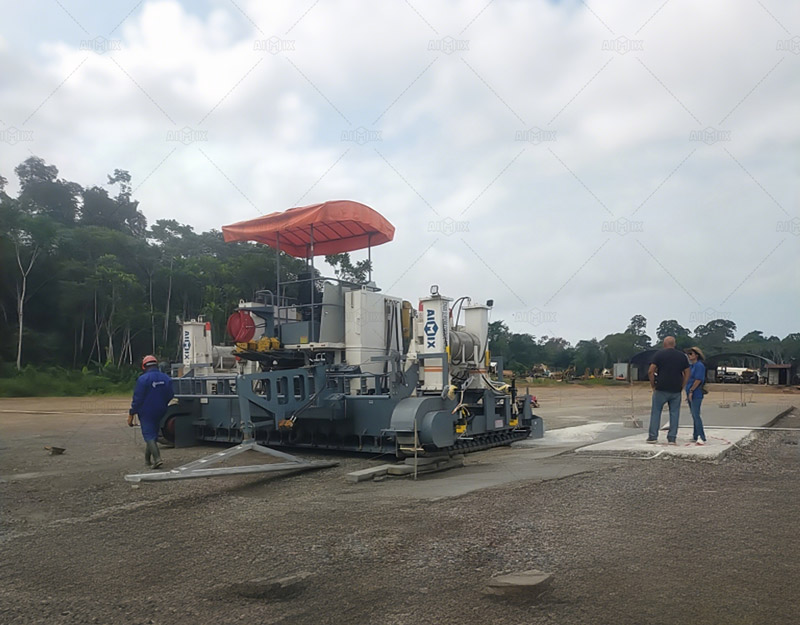
Concrete pavement construction often follows a linear progression. The paving machine advances along a prepared section while fresh concrete must arrive at a relatively stable interval. Unlike ordinary concrete works, where individual foundations or structural elements can sometimes be poured separately, pavement construction benefits from continuity across the placement zone.
This creates a production rhythm. The batching plant produces concrete, mixer trucks transport successive loads, and the paving machine consumes the material at a predetermined rate. If the production rate is too low, the paver may slow down or stop. If deliveries arrive too quickly, trucks can accumulate around the work area and complicate site logistics.
Concrete Consistency Matters as Much as Concrete Volume
Large pavement projects do not simply require a large quantity of concrete. They require concrete with sufficiently stable properties from one load to the next. Variations in aggregate proportions, water content, slump, mixing time, or delivery duration can influence workability and finishing behavior.
A well-organized batching system therefore acts as the upstream control point. Accurate aggregate dosing and controlled mixing establish a repeatable concrete composition, while the transportation stage must preserve that condition until the concrete reaches the concrete paving machine.
The Paving Machine Becomes the Downstream Production Regulator
The paving rate provides an important reference for the entire concrete supply chain. A high-output paving operation can consume concrete rapidly, meaning the batching plant and truck fleet must be capable of replenishing material without prolonged interruptions.
In effect, the paving machine creates a downstream demand signal. Production and delivery capacity should be planned backward from the required paving rate rather than selected independently.
Connecting Concrete Production With Transportation and Paving
Mobile Concrete Batch Plant as the Upstream Supply Hub
A mobile concrete batch plant is particularly useful for large pavement projects where the construction area may extend across considerable distances or where the concrete production facility needs to remain close to the active work front. Its mobility allows the production point to be positioned according to project logistics instead of relying entirely on a distant permanent concrete plant.
The plant receives and proportionally doses aggregates, cement, water, and other mix components before producing concrete for transportation. Its effective capacity should be evaluated against the required paving rate, haul distance, truck loading cycle, and expected interruptions rather than theoretical hourly output alone.
For projects with shifting construction zones, the mobile configuration can also simplify future relocation. This is particularly pertinent to highway and large industrial pavement projects where the active paving section may move progressively through the site.
Concrete Mixer Trucks Bridge Production and Placement
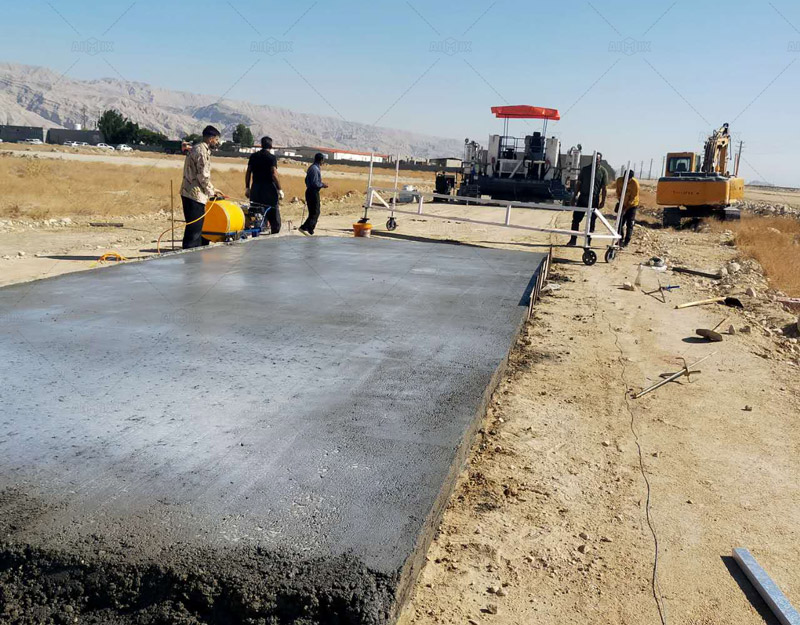
Concrete mixer trucks form the logistical bridge between batching and paving. Their role is more nuanced than simply transporting concrete. The truck fleet determines whether the material reaches the paving front at the right frequency and within an acceptable travel time.
Suppose the paving operation consumes concrete continuously while the portable concrete batching plant is located several kilometers from the work front. The required number of trucks depends on loading time, travel time, unloading duration, return travel, traffic conditions, and contingency allowance. A fleet that appears sufficient on paper may prove inadequate when site roads become congested or rough.
Consequently, truck scheduling should be based on the complete transportation cycle. The objective is to maintain a circulating fleet rather than simply maximize the number of trucks operating simultaneously.
Concrete Paving Machine Converts Supply Into Pavement
The concrete paving machine is the final major component of the production chain. Depending on the project design, the machine may distribute fresh concrete across the pavement width, control the paving profile, compact the concrete, and establish the required surface geometry.
Its operating speed should correspond with the concrete supply rate. A sophisticated paver cannot compensate for an irregular upstream supply. Conversely, excessive concrete production offers little benefit if the paving system cannot consume the material efficiently.
How Construction Characteristics Shape Equipment Coordination
Long Pavement Sections Require a Stable Material Flow
Highway and airport pavement projects frequently involve long continuous sections. The construction front may extend for hundreds of meters, making concrete transportation distance a significant operational variable.
As the paving front moves, the distance between the batching plant and active placement area may change. This can alter truck cycle times and gradually increase the risk of supply interruptions. A mobile batching plant can reduce this logistical drift by relocating production when the project reaches a new operational phase.
Prepared Subgrade Controls the Paving Rhythm
Concrete placement cannot compensate for an inadequately prepared pavement base. Grading, compaction, reinforcement or dowel installation, formwork where required, and other preparatory activities must stay ahead of the paver.
This creates a sequential chain: subgrade preparation establishes the work front, concrete production feeds the placement operation, trucks maintain material continuity, and the paver converts the fresh mixture into the designed pavement profile. If preparation falls behind, the concrete supply system may accumulate unused capacity.
Weather and Site Conditions Can Disturb Delivery Timing
Large pavement projects are sensitive to environmental and logistical variability. Heat can influence concrete workability and setting behavior, while rain can interrupt placement or affect prepared surfaces. Traffic restrictions, temporary access roads, and long internal haul routes can also extend truck cycle times.
These variables make contingency planning essential. Additional transportation capacity, strategically positioned production equipment, and flexible paving schedules can help absorb short-term disturbances without destabilizing the entire operation.
Building an Efficient Concrete Pavement Equipment Chain
Match Batching Capacity With Paving Consumption
The first step is to calculate the concrete volume required per hour of paving. Pavement width, thickness, paving speed, and concrete density establish the approximate consumption rate. The batching plant should then provide sufficient effective output to maintain that rate while allowing reasonable operational reserves.
The distinction between theoretical and effective capacity is important. Aggregate loading, material replenishment, mixer cycles, maintenance, and operator procedures all influence actual production. A plant with nominally high capacity may still underperform if its supporting logistics are inadequate.
Calculate the Mixer Truck Fleet From the Full Cycle
Truck requirements should be derived from the complete loading-to-return cycle. If one truck spends substantial time traveling between the batching plant and paving front, additional units may be required to keep the paver supplied continuously.
Fleet planning should therefore consider loading, transit, site entry, discharge, cleaning procedures, and return travel. The result is a synchronized circulation pattern in which trucks arrive before the paving operation exhausts its available concrete.
Select the Concrete Paver Machine According to Pavement Scale
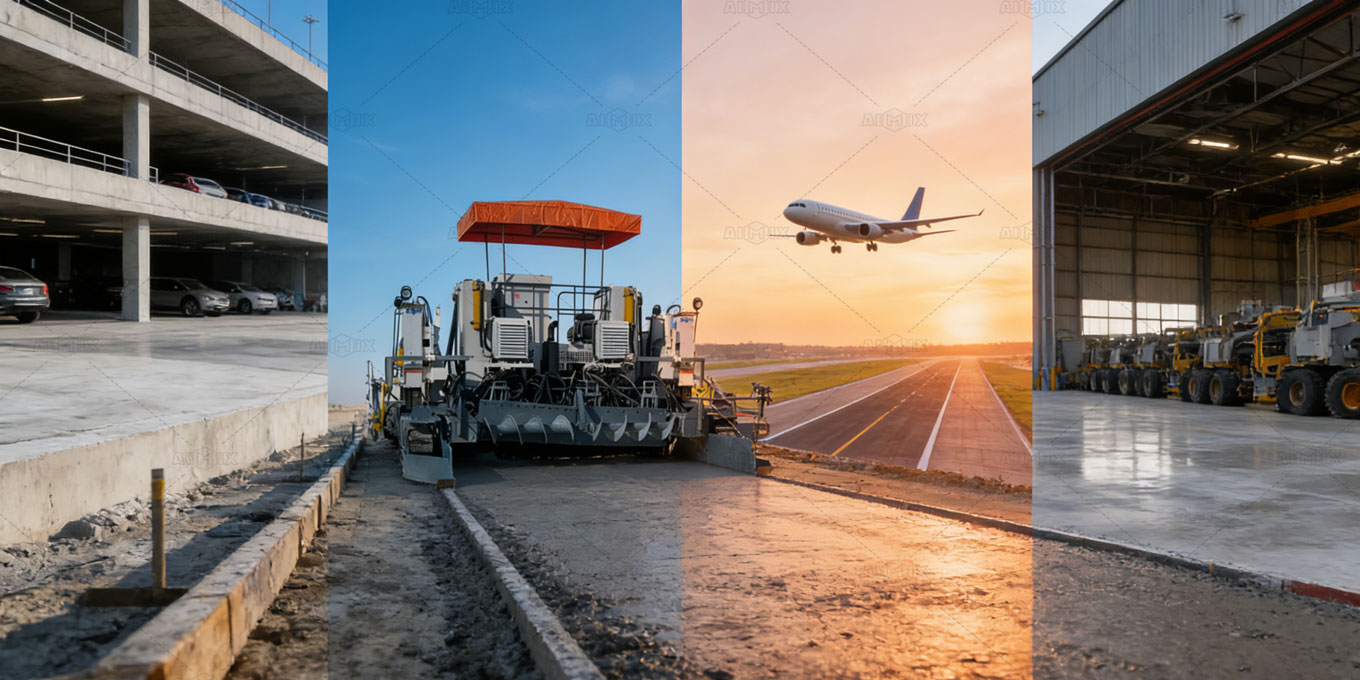
A concrete paver machine for sale should be evaluated according to paving width, required output, pavement thickness, project geometry, and desired degree of automation. Large highway or airport pavement projects generally demand equipment capable of maintaining a stable paving profile over substantial distances.
Smaller industrial yards, access roads, and localized pavement works may require a different configuration. The key is proportionality. The paver, batching plant, and truck fleet should form a balanced system rather than three independently optimized machines.
Large concrete pavement construction is ultimately an exercise in synchronization. The mobile concrete batch plant sale establishes the upstream production rhythm, concrete mixer trucks maintain the material flow, and the concrete paving machine transforms that supply into a continuous pavement structure. When production exceeds paving capacity, material accumulates; when transportation falls behind, paving slows; when the paver outpaces supply, continuity is compromised. Matching these three stages to pavement width, construction speed, haul distance, site preparation, and environmental conditions creates a more resilient workflow. For contractors evaluating a concrete paver machine for sale, the most meaningful question is therefore not simply machine capacity, but how effectively the entire concrete production-to-paving chain can operate as one integrated construction system.