Precast concrete plants rely on efficient material handling systems to keep production running smoothly. From lifting massive bridge girders and wall panels to transporting heavy beams and columns across storage yards, the right lifting equipment directly impacts productivity, safety, and operating costs.
Among the available lifting solutions, the 100 ton gantry crane has become a preferred choice for many medium- and large-scale precast concrete manufacturers. Its high lifting capacity, wide working coverage, and ability to operate outdoors make it ideal for handling oversized concrete components throughout the production process.
This guide explains the key features of a 100 ton gantry crane, its advantages in precast concrete plants, and the factors you should consider before purchasing one.
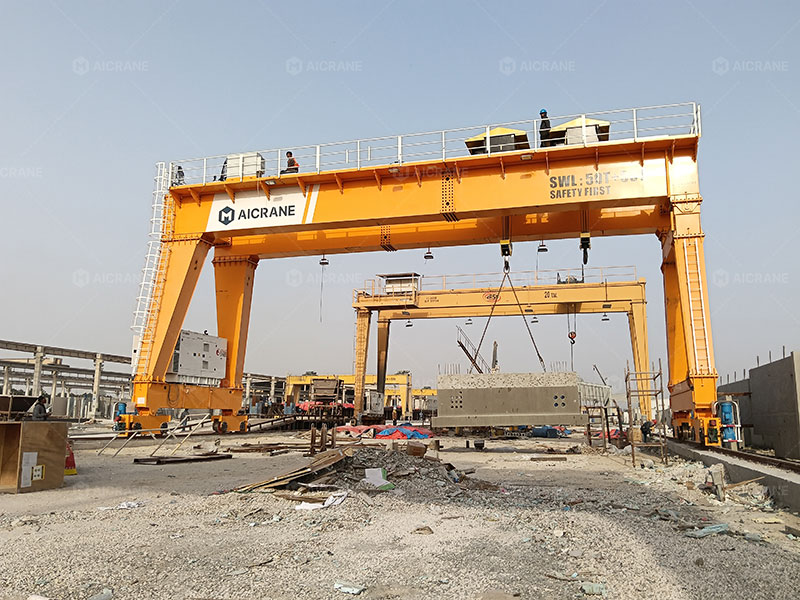
Why Precast Concrete Plants Need a 100 Ton Gantry Crane
As infrastructure projects continue to grow in size and complexity, precast manufacturers are producing increasingly larger and heavier concrete elements. These may include:
- Bridge girders
- Box girders
- Concrete beams
- Wall panels
- Tunnel segments
- Precast columns
- Box culverts
- Large slabs
- Customized structural components
Many of these products weigh tens of tons, making manual handling or smaller cranes impractical. A 100 ton gantry crane provides sufficient lifting capacity while covering large production and storage areas, allowing materials to move efficiently between casting beds, curing areas, storage yards, and loading zones.
Compared with installing multiple lifting systems, a properly designed gantry crane can simplify plant logistics, improve workflow, and reduce material handling time.
Key Features of a 100 Ton Gantry Crane
Heavy-Duty Double Girder Structure
Most 100 ton gantry cranes use a double girder design because it offers excellent rigidity and load-bearing performance.
Compared with a single girder configuration, double girder gantry cranes provide:
- Higher lifting capacity
- Better structural stability
- Reduced beam deflection
- Greater lifting height
- Longer service life
This design is particularly suitable for continuously lifting heavy precast concrete products.
Wide Span for Large Production Areas
Precast concrete plants usually require large open working spaces.
A 100 ton gantry crane can be customized with spans ranging from approximately 20 to over 40 meters, depending on the production layout.
A wider span allows one crane to serve:
- Multiple production lines
- Storage yards
- Concrete curing areas
- Truck loading zones
This minimizes equipment relocation while improving overall operational efficiency.
High Lifting Height
Large concrete components often require additional clearance during transportation and stacking.
A customized lifting height enables operators to:
- Stack products efficiently
- Move oversized beams safely
- Avoid interference with nearby equipment
- Maximize storage capacity
The lifting height should always be selected according to the dimensions of the largest precast products handled in the plant.
Stable Outdoor Operation
Unlike overhead cranes installed inside workshops, gantry cranes frequently operate outdoors.
Typical outdoor design features include:
- Wind-resistant steel structure
- Heavy-duty wheel assemblies
- Rail-mounted travel mechanism
- Corrosion-resistant coating systems
- Weather-protected electrical components
These features help ensure reliable operation under various environmental conditions.
Customized Hoisting System
Different precast products require different lifting methods.
A 100 ton gantry crane may be equipped with:
- Dual-hook systems
- Adjustable lifting beams
- Spreader beams
- Customized lifting fixtures
- Variable-speed hoists
Selecting the appropriate lifting attachment helps improve handling efficiency while reducing the risk of damaging finished concrete components.
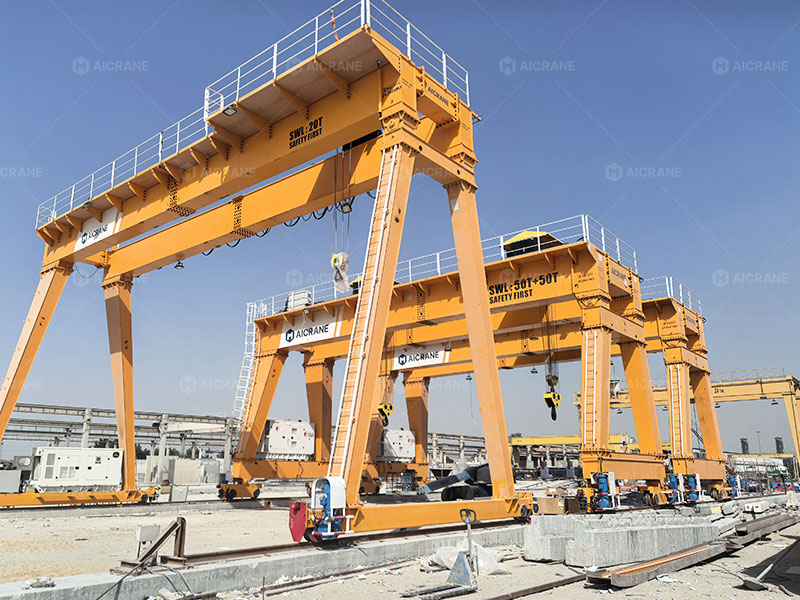
Benefits of Using a 100 Ton Gantry Crane in a Precast Concrete Plant
Higher Production Efficiency
Large precast components can be transferred quickly between production stages without waiting for multiple smaller lifting devices.
Efficient material handling minimizes production bottlenecks and supports continuous manufacturing.
Improved Safety
Heavy concrete elements present significant safety risks if handled improperly.
A properly designed gantry crane provides:
- Smooth lifting control
- Stable load movement
- Accurate positioning
- Reduced manual handling
- Advanced overload protection
These features help improve workplace safety while reducing equipment damage.
Lower Labor Costs
Automated lifting significantly decreases the need for manual handling.
Instead of relying on multiple forklifts, mobile cranes, and workers, one gantry crane can complete most heavy lifting tasks efficiently, reducing labor costs and improving operational consistency.
Better Yard Utilization
Because gantry cranes travel along fixed rails, they can cover large working areas without occupying valuable production space.
Operators can:
- Stack products higher
- Organize storage more efficiently
- Improve truck loading operations
- Increase overall yard capacity
Long-Term Reliability
Heavy-duty steel structures, high-quality welding, and carefully selected components enable a well-maintained gantry crane to provide reliable performance for many years.
Routine inspections and preventive maintenance further extend equipment service life while minimizing unexpected downtime.
Typical Applications in Precast Concrete Plants
A 100 ton gantry crane supports nearly every stage of precast concrete production.
Typical applications include:
- Removing finished products from casting molds
- Transporting concrete beams and girders
- Moving bridge segments
- Handling tunnel lining segments
- Lifting precast columns
- Organizing storage yards
- Loading trailers for transportation
- Supporting infrastructure construction projects
Since every production facility has different workflows and layouts, many manufacturers choose customized gantry crane configurations rather than standard models.
Important Buying Considerations
Selecting the right gantry crane involves much more than simply choosing a lifting capacity.
Lifting Capacity
Although the crane is rated for 100 tons, buyers should evaluate:
- Maximum product weight
- Weight of lifting devices
- Future production expansion
- Required safety margins
Avoid selecting equipment that will operate continuously near its maximum rated capacity.
Span Length
The crane span should match the production layout.
An excessively wide span increases structural cost, while an insufficient span limits working coverage.
Professional layout analysis helps determine the most economical span.
Lifting Height
Consider:
- Product dimensions
- Required stacking height
- Trailer loading requirements
- Future production expansion
Selecting the appropriate lifting height prevents operational limitations as production grows.
Work Duty Classification
Precast plants often operate continuously under demanding conditions.
A crane designed for heavy-duty service offers:
- Longer component life
- Better durability
- Reduced maintenance requirements
- Higher operational reliability
Choosing the appropriate duty classification is essential for long-term performance.
Control Options
Modern gantry cranes can be operated using:
- Pendant controls
- Wireless remote controls
- Operator cabins
- Semi-automated control systems
Wireless remote control is increasingly popular because it offers better visibility, flexibility, and operator safety.
Safety Features
A quality 100 ton gantry crane should include:
- Overload protection
- Emergency stop buttons
- Upper and lower limit switches
- Anti-collision systems
- Rail clamps
- Wind speed alarms
- Travel limit protection
- Motor overload protection
These safety systems help protect both personnel and equipment during daily operation.
Environmental Conditions
Outdoor operating environments should also be considered during crane design.
Manufacturers should evaluate:
- Maximum wind speed
- Ambient temperature
- Rainfall
- Humidity
- Dust exposure
- Corrosive environments
These conditions influence structural design, coating systems, and electrical component protection.
Should You Choose a Standard or Customized Gantry Crane?
Every precast concrete plant has unique production requirements.
A customized 100 ton gantry crane can be designed according to:
- Plant dimensions
- Product sizes
- Production capacity
- Travel distance
- Lifting height
- Power supply
- Control preferences
- Future expansion plans
Although standard models may reduce initial investment, customized solutions often deliver higher productivity, better space utilization, and lower operating costs throughout the crane’s service life.
Tips for Choosing a Reliable Manufacturer
Selecting an experienced manufacturer is just as important as selecting the crane itself.
Look for suppliers that provide:
- Customized engineering solutions
- Structural calculations
- Finite Element Analysis (FEA)
- Certified welding procedures
- Factory load testing
- Installation guidance
- Operator training
- Spare parts availability
- Comprehensive after-sales service
- Compliance with international crane standards
Reviewing previous precast concrete projects can also help evaluate a manufacturer’s experience with similar lifting applications.
Frequently Asked Questions
Is a 100 ton gantry crane suitable for every precast concrete plant?
Not necessarily. While a 100 ton gantry crane is ideal for handling large and heavy precast components, smaller plants producing lighter products may require lower-capacity cranes. Capacity should always be selected based on actual lifting requirements and future production plans.
Can the crane be customized for different plant layouts?
Yes. Manufacturers can customize span, lifting height, cantilever length, travel distance, hoisting speed, control system, and power supply to match specific plant layouts and production processes.
What safety features are essential?
Essential safety features include overload protection, emergency stop systems, travel limit switches, anti-collision devices, rail clamps, wind alarms, and motor protection systems to ensure safe operation.
How long does a 100 ton gantry crane typically last?
With proper maintenance, quality components, and routine inspections, a heavy duty gantry crane can provide reliable service for 20 years or longer, depending on operating conditions and workload.
What information should buyers prepare before requesting a quotation?
Providing details such as lifting capacity, span, lifting height, product dimensions, duty classification, operating environment, power supply, and site layout enables manufacturers to recommend the most suitable crane solution.
Conclusion
A 100 ton gantry crane is a valuable investment for precast concrete plants that handle heavy structural components every day. Its robust lifting capacity, customizable design, and ability to improve material handling efficiency make it an essential solution for modern precast manufacturing.
When selecting a crane, buyers should evaluate not only lifting capacity but also span, lifting height, work duty, safety systems, operating environment, and future production requirements. Partnering with an experienced manufacturer capable of providing customized engineering, quality manufacturing, and dependable after-sales support helps ensure long-term performance and a stronger return on investment.
Whether your facility produces bridge girders, concrete beams, tunnel segments, wall panels, or other large precast components, choosing the right 100 ton gantry crane can significantly improve productivity, operational safety, and overall plant efficiency.